

The $750 Billion Gamble: Is Openai Running Out Of Time?
Look, we've all been there. You start a project, everything feels electric, you’re miles ahead of everyone else, and then... the rest of the world catches up while your bills start piling up on the kitchen table.
That’s pretty much where OpenAI finds itself right now.
Remember back in 2022 when ChatGPT felt like actual black magic? We were all blown away, playing with prompts, convincing ourselves the future had arrived overnight. But fast forward to early 2026, and the ground under the AI giant is shifting in a big, uncomfortable way.
The numbers floating around right now are honestly dizzying. In Q1 of 2026, OpenAI reported an operating loss of $6.95 billion against $5.7 billion in revenue. That means for every single dollar they brought in, they burned through more than two dollars. Their operating margin hit -122%.
Even Sam Altman recently admitted, "We have not had our best 12 months ever, and it's mostly my fault."
So... what actually went wrong? How did the company that kicked off the modern AI revolution end up facing such a massive squeeze?
The Market Share Myth & The Enterprise Slip
If you look purely at headline user numbers, OpenAI still looks like an unstoppable monster. ChatGPT boasts over 900 million weekly active users. But when you look under the hood, those big numbers hide a much tougher reality:
- The Free-Tier Problem: Roughly 95% of those 900 million users use the free version. Converting casual users into paying subscribers has hit a brick wall.
- The Global Assistant Drop: ChatGPT’s market share for AI assistants recently dipped below 50% for the first time ever—sitting around 46%, with Google’s Gemini climbing fast at 28% and Anthropic’s Claude holding 10%.
- Where the Real Money Is (Enterprise): Back in 2023, OpenAI owned about 50% of corporate LLM spending. Today, that enterprise share has plummeted to 27%. Meanwhile, Anthropic snatched up 40% of the market (and a staggering 54% of the high-value coding segment).
When big companies and developers start switching to competitor tools for coding and heavy infrastructure... that hurts where it counts.
The Ad Revenue Mirage
To fix the free-tier problem, OpenAI banked heavily on advertisements, setting a wild goal of $100 billion in ad revenue by 2030.
It sounded great on paper, but the reality of how people interact with AI ruined the plan.
Think about how you use ChatGPT. You're usually asking for a specific code snippet, drafting an email, or asking a complex question. Turns out, only about 2% of ChatGPT prompts actually involve purchasable products. You can't naturally slip a shoe ad into a request to fix a Python script without completely ruining the experience.
Because of this, click-through rates on ChatGPT ads are sitting at a brutal 0.91% to 1.3% (compared to Google Search ads, which pull around 29%). Current estimates suggest the entire U.S. chatbot ad market won't even hit $5.5 billion by 2030... making OpenAI’s target nearly 20 times larger than the entire market potential.
The Commoditization Trap: When "Intelligence" Becomes Cheap
Here’s where things get really fascinating (and a little ironic).
Back in mid-2025, Sam Altman wrote an essay mentioning that as data center production becomes automated, the cost of intelligence should eventually converge to near the cost of electricity.
And he was right! But that's a double-edged sword.
In 2023, both high-end GPUs and advanced AI models were rare. By 2026, models aren't rare anymore. The performance gap between closed commercial models and open-weight models has shrunk to almost nothing (dropping from over 8% down to under 1.7% on standard benchmarks).
AI models are fast becoming a commodity—just like electricity or gigabit internet.
- A gigabit from Provider A feels the exact same as a gigabit from Provider B, so customers just shop on price.
- Token prices have plummeted by nearly 90% since 2023.
When intelligence becomes cheap and interchangeable, the real profits move elsewhere in the stack. They move down to the hardware manufacturers—like NVIDIA, whose data center revenue hit $75.2 billion with 75% gross margins.
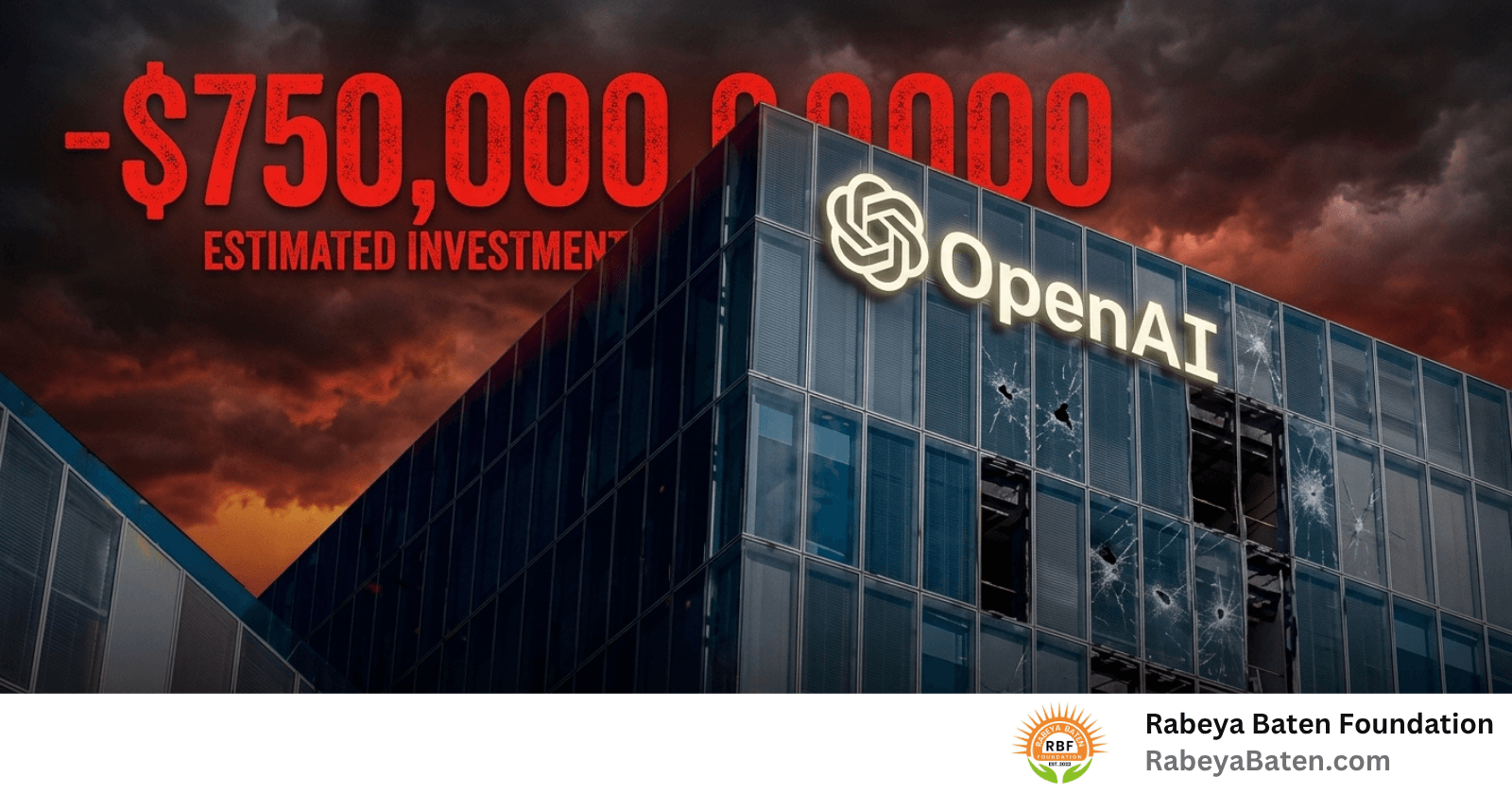
OpenAI is essentially locked into the least profitable layer: building and running massive raw models while being bound to $750 billion in contractual spending commitments through 2030 with Oracle, AWS, Microsoft Azure, and Broadcom.
Can They Turn It Around?
They aren't out of runway just yet. With roughly $73 billion in cash reserves and backing from tech jugganauts in massive funding rounds, OpenAI has enough space to make big strategic pivots. Pushing their public offering (IPO) back gives them time to figure out their unit economics.
Whether they can re-capture the enterprise lead or figure out a new monetization engine is the billion-dollar (or rather, $750-billion) question.